Overview
Etsy Promotions Vision 2026
Using design to help shape what we prioritize next.
I initiated this work after seeing a recurring need for a clearer long-term direction across Etsy Promotions. I brought together years of product learning, competitive analysis, seller research, and previous team thinking to build an evidence-backed case for where the experience could go next.
What began as a self-initiated exploration has gradually become a shared direction with my squad. We’re now using the vision to discuss what we can address incrementally, what requires foundational work, and how those opportunities could inform future planning.
- Role
- Design Lead
- Company
- Etsy
- Year
- 2026
- Scope
- Promotions ecosystem
- Status
- In development
The challenge
Growing the product without losing the system
Over several years, Etsy Promotions had continued to expand. New promotion types, targeting strategies, controls, and seller capabilities created more ways for sellers to reach buyers—but each addition also became part of an increasingly complex ecosystem.
Working across Promotions gave me a close view of that evolution. Individual projects could improve specific parts of the experience, but I kept seeing problems that were bigger than any one initiative.
01
A growing ecosystem
Promotions had grown through years of adding new offer types, targeting strategies, controls, and seller capabilities. Each addition solved a real product need, but together they were also making the experience increasingly complex.
Rather than optimizing within the existing Promotions model, I stepped back to reconsider the model itself. This created space to explore a new paradigm shaped by seller needs and long-term product opportunities, rather than by the structure of the experience today.
02
Incremental improvements couldn’t answer the bigger question
Individual teams could continue improving specific parts of Promotions, but those projects were necessarily grounded in the product as it exists today.
I saw an opportunity to step outside those constraints and explore a longer-term direction based on seller needs, accumulated product learning, and where the market was evolving—not simply on the architecture of the current experience.
A long-term vision could create space to challenge existing assumptions before deciding which parts of today’s experience should evolve, which should remain, and which might need to be fundamentally reconsidered.
03
The opportunity wasn’t on the roadmap
There wasn’t a brief or leadership initiative asking me to create a Promotions vision.
I believed Design could contribute before a project reached the roadmap: by identifying recurring problems, gathering evidence, and making future possibilities concrete enough for the team to evaluate.
Design can help shape the roadmap before it executes against it.
What should Promotions on Etsy become?
Key decisions
01
Build evidence for the opportunity
If I wanted the vision to influence future priorities, it couldn’t begin with a design concept. I needed to make the opportunity—and the problems behind it—concrete.
This wasn’t a single discovery phase. My understanding of the space had been accumulating through several years of working in Promotions.
In 2024, I analyzed how other platforms approached promotions. In 2025, I expanded that perspective with a broader analysis of marketing tools, looking beyond discounts to understand how other products helped businesses reach and engage customers.
In 2026, I returned to Promotions with another competitive refresh, now informed by additional product work and a more mature understanding of Etsy’s ecosystem.
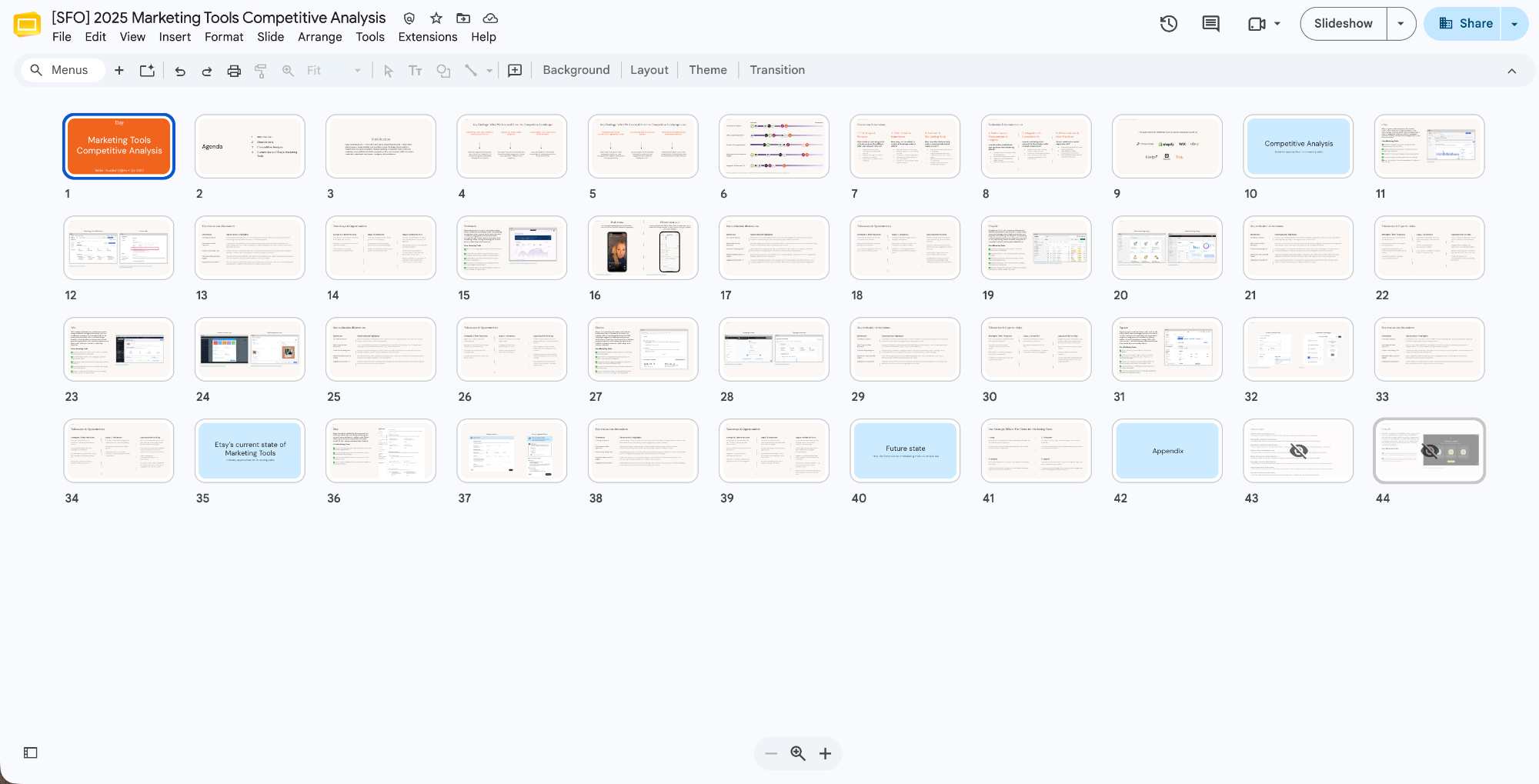
2025
Marketing tools competitive analysis
2026
Promotions competitive refresh
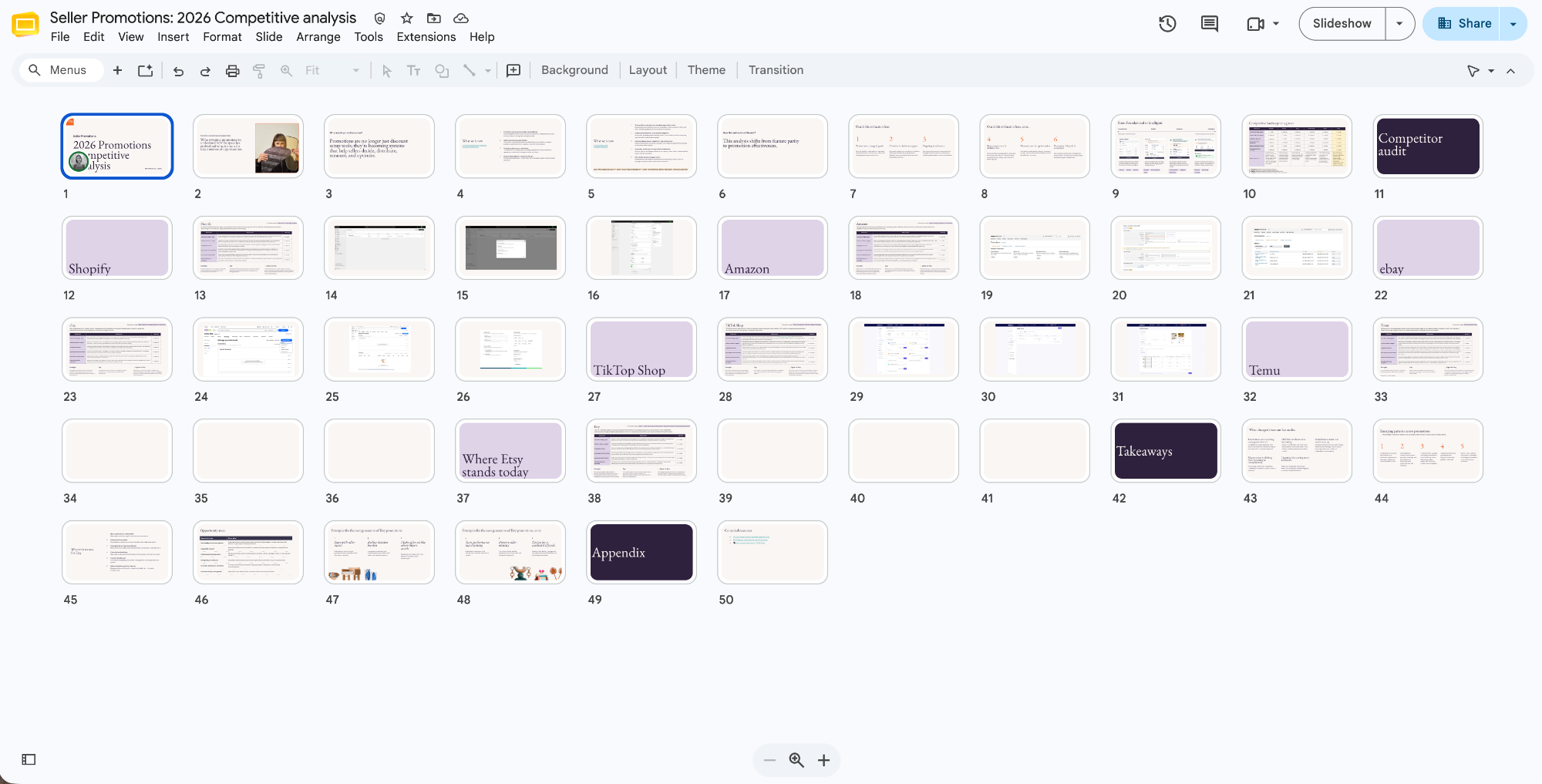
Building a body of evidence over time. The analyses evolved alongside my understanding of the product—from individual promotion mechanics toward the broader system sellers use to market their businesses. These analyses were only one input. I also brought together learnings from previous Promotions initiatives, earlier conversations about creating a North Star for the suite, existing product knowledge, and more recent seller research.
The evidence reinforced that many of the challenges we were seeing weren’t isolated feature problems. They were recurring tensions across the system: giving sellers more power without adding unnecessary complexity, increasing reach while preserving control, and introducing smarter capabilities while maintaining transparency and trust.
02
Turn evidence into a point of view
Accumulating evidence wasn’t enough. A vision couldn’t simply become a collection of every problem we had found or every feature we could build.
The next step was synthesis.
I brought the problem space into a workshop designed to move from individual seller problems toward broader experience principles.
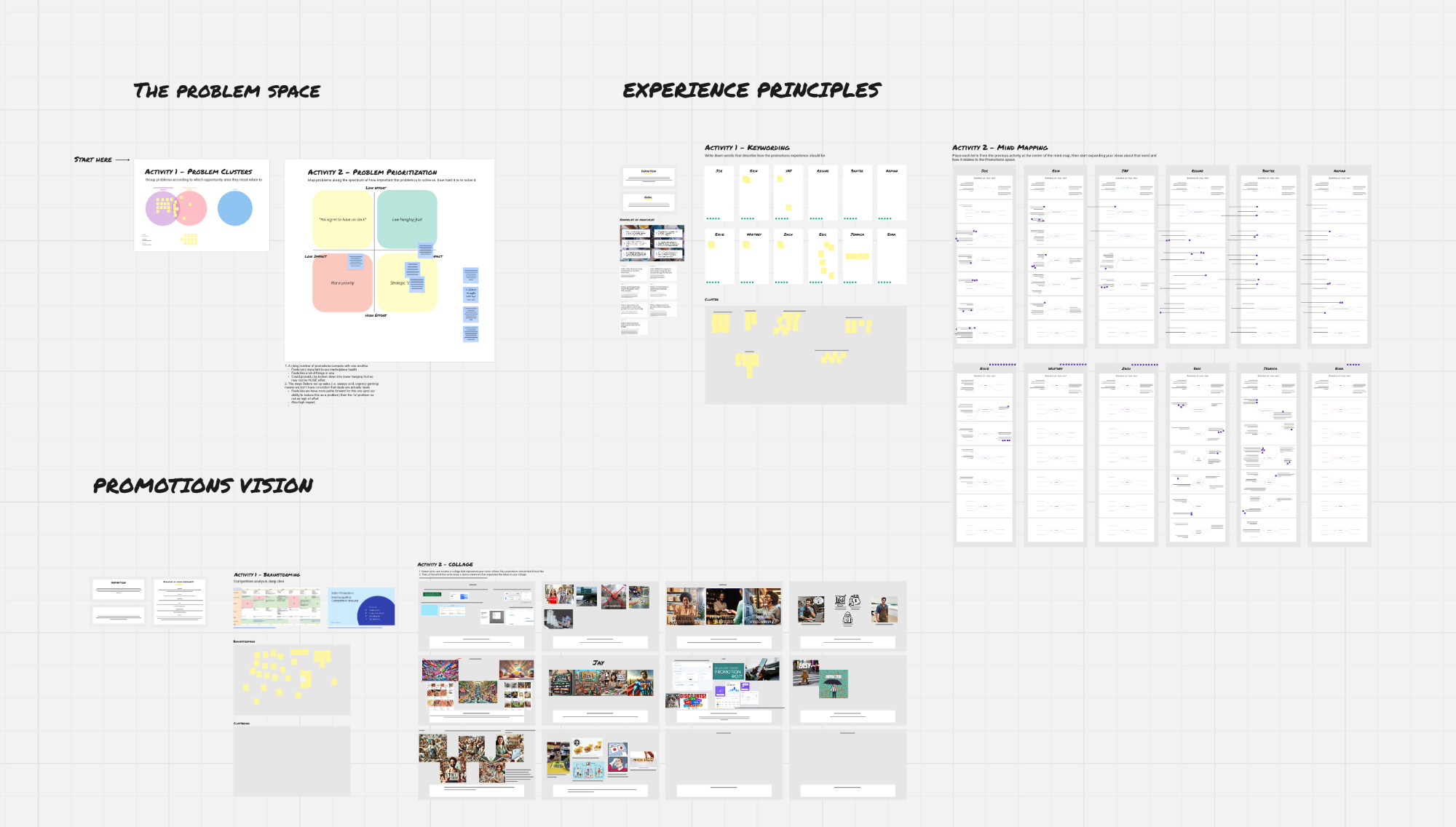
Moving from individual problems toward principles. The workshop helped turn a large body of product and seller evidence into a smaller set of ideas that could guide the system as it evolves. Rather than asking what features Promotions should have in the future, we focused on the recurring problems sellers were trying to solve and the qualities a future experience would need to support them.
The goal wasn’t to turn every finding into a feature. It was to establish a point of view strong enough to guide decisions even as the product continued to change.
03
Make the future concrete enough to plan toward
A set of principles can establish direction, but it can still leave too much room for interpretation.
I wanted the vision to be tangible enough that the team could react to it—not as a final interface we had committed to building, but as a way to explore what those principles might mean when applied to the product.
I began translating the direction into a future-state experience that explored what Promotions could become if we designed from the seller problems we wanted to solve, rather than from the structure of the product today.
The work helped move conversations from abstract questions about the future of Promotions toward more concrete ones:
What could we improve incrementally?
What requires foundational changes?
Which opportunities could begin informing future planning?
The prototype became less about proposing a final design and more about creating something the team could use to reason about the future.
Outcome
Influencing what comes next
This work didn’t begin with an assigned initiative. It began with a point of view that I believed was worth investigating.
As I gathered evidence and made the opportunity more concrete, my squad became part of shaping the direction. The vision is already informing some of our decisions: we’ve identified incremental improvements that are valuable on their own while also moving the product toward the longer-term direction. In parallel, we’re continuing to discuss what requires more foundational work and how larger opportunities could inform future planning.
The vision is still in development.
Its impact today isn’t a shipped future-state experience or a final roadmap. It’s an evidence-backed direction that is already helping us make decisions in the present while creating a clearer path for where Promotions could go next.
The vision
Strategic vision — In development
I expect the vision itself to continue changing as we learn more. That’s part of its purpose: not to prescribe a fixed destination, but to give the team a shared direction against which future decisions can be evaluated.
Looking back
Design can influence product direction before initiatives are formally prioritized.
By identifying recurring opportunities, building an evidence base, and making future possibilities tangible, Design can help teams evaluate where to invest next. The vision has already helped our squad identify incremental improvements that are valuable on their own while also moving the product toward the longer-term direction.
A vision needs evidence before it needs screens.
Starting with years of product learning, competitive analysis, and seller research helped me separate a meaningful long-term opportunity from an interesting design exercise. The prototype became useful because there was already a case for why the direction mattered.
A North Star should create conversations, not end them.
The value of the vision isn’t in predicting exactly what Promotions will look like in the future. It gives the team something concrete enough to challenge, evolve, and plan toward as priorities and constraints change.