Overview
Etsy Sales and Discounts Redesign
Turning a performance fix into a clearer, faster, and more scalable seller experience.
+0.71%
sellers creating promotions
>1 sec
improvement in p90 load time
Positive signal
fewer sellers ending sales early
- Role
- Design Lead
- Company
- Etsy
- Year
- 2024
- Method
- A/B test
- Status
- Shipped
I helped expand the project from a performance-focused fix into a broader redesign of the Sales and discounts experience. Using qualitative seller insights, I partnered with Product, Engineering, and Analytics to make the case for improving the front end as well as the underlying performance.
The challenge
The page had become a technical problem, but the deeper issue was that sellers were struggling to understand the system itself.
01
Fragmented product growth
From 2022 to 2024, new promotion types were added to the existing Sales and discounts page. Over time, the experience became harder to scan, compare, and understand.
02
Performance and technical debt
Power Sellers with large promotion tables experienced serious load issues, while the underlying codebase had become brittle and expensive to maintain.
03
A narrow initial scope
The project initially focused on fixing performance. But qualitative seller research already suggested that some sellers were not fully familiar with how Etsy’s promotion tools worked.
That created an opportunity: instead of only making the page faster, we could also make the system easier to understand.
Key decisions
01
Expand the scope beyond performance
We broadened the work from a performance fix into a combined product and technical redesign.
The original goal was to address performance issues, but qualitative seller research pointed to a second problem: some sellers were not fully familiar with how different promotion types worked.
I brought that insight into conversations with Product, Engineering, and Analytics and advocated for expanding the scope to include a front-end redesign.
Fixing load time alone would have improved reliability, but it would not have addressed the confusion sellers experienced when deciding which promotion to use.
Initial brief
Improve page performance
Reframed problem
Make the experience faster and easier to understand
02
Organize around seller goals, not promotion types
Sellers did not necessarily know the differences between every promotion type, but they generally knew what they wanted to achieve.
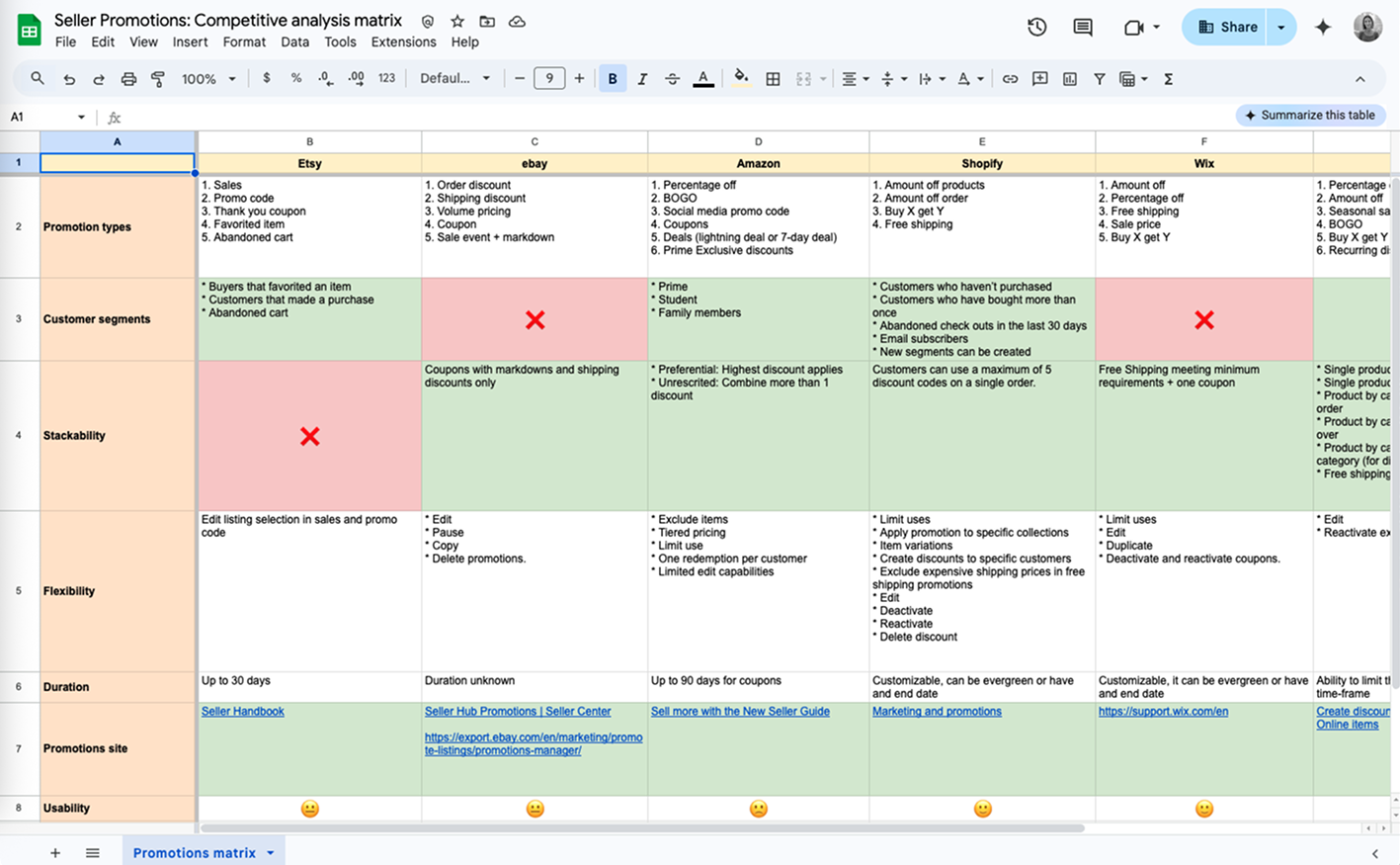
Looking beyond promotion types. I compared how other marketplaces structured their promotion ecosystems and exposed sellers to different promotional options. Competitive analysis helped me understand how other marketplaces structured their promotion ecosystems and exposed sellers to different promotional options.
Combined with previous seller research, this reinforced an important distinction: sellers might not know which promotion type to choose, but they usually knew what they wanted to achieve.
Instead of asking sellers to understand Etsy’s promotion taxonomy first, I organized the experience around seller goals.
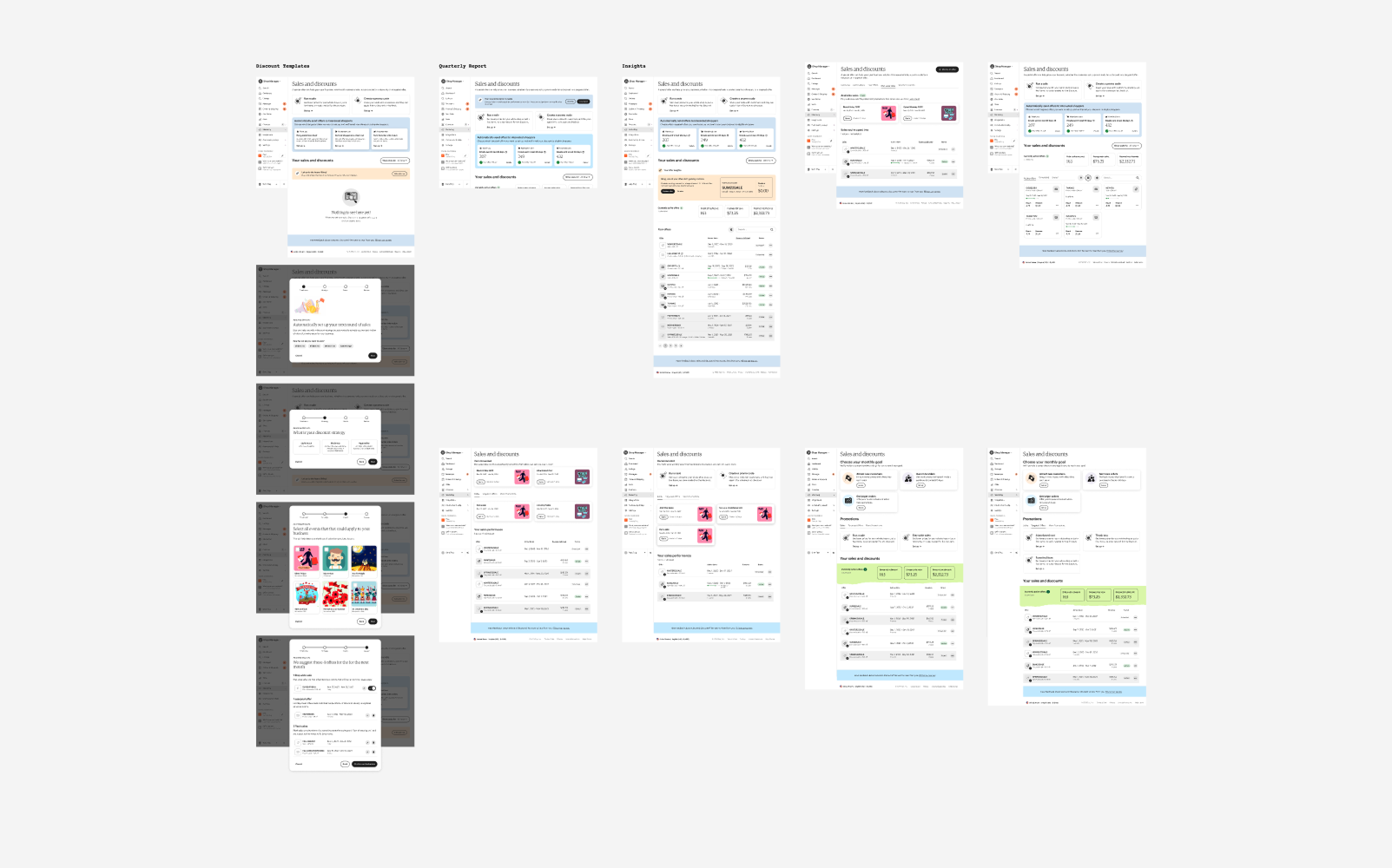
Exploring different ways to structure a growing system. I tested multiple approaches to hierarchy, grouping, and how sellers could move between choosing a promotion and managing existing ones. This shifted the information architecture from a product-centered model to a seller-centered one.
Outcome
The experience
01
Goal-based organization
Promotion tools were grouped around seller outcomes, helping sellers start from what they wanted to achieve rather than from the mechanics of each promotion type.
02
Scalable structure
The redesigned structure gave the experience a clearer foundation for adding and maintaining promotional tools over time.
03
Performance improvements
The promotions table was optimized to load faster and more reliably, especially for Power Sellers managing larger datasets.
Impact
- +0.71% sellers with promotion_created
- >1 sec faster p90 page load
- Positive signal fewer sellers ending sales early
The redesign improved both promotion creation and page performance, validating the decision to solve the product and technical problems together.
What began as a performance project became an opportunity to improve how sellers understood and navigated Etsy’s promotion system.
Looking back
The initial brief is not always the whole problem.
The project started as a performance fix. Qualitative seller insight helped reveal that reliability and comprehension were connected, and gave us a stronger case for expanding the scope.
Users understand goals before they understand product taxonomy.
Sellers did not need to become experts in every promotion type before taking action. Organizing around what they wanted to achieve created a more intuitive entry point into the system.
Product and technical scalability are easier to solve together.
The redesign worked because we addressed information architecture, performance, and maintainability as parts of the same system rather than as separate problems.